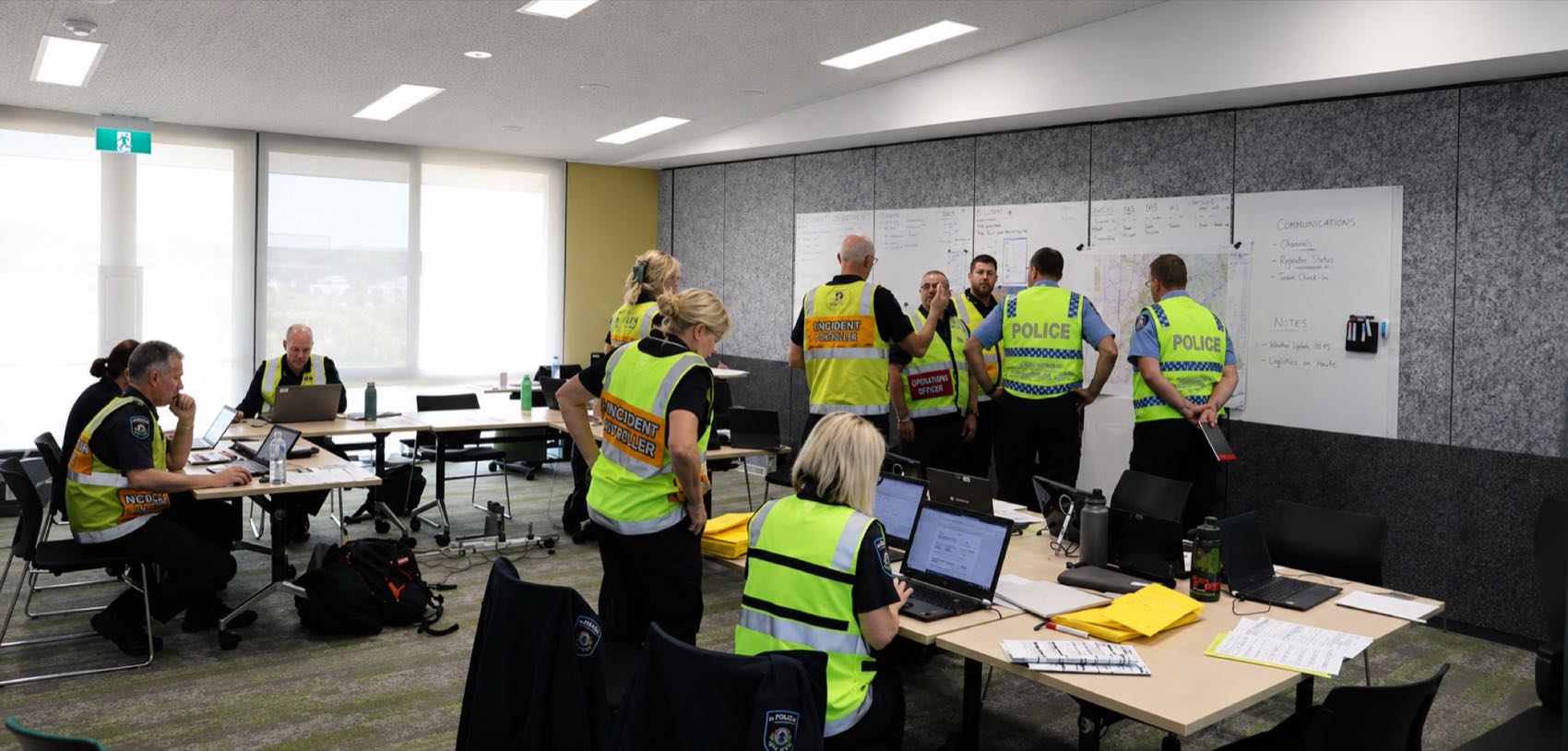
Incident Management Teams, on call or built in-house.
AIIMS-aligned Incident Management Team support and development, plus Crisis Management Intervention for the executives and Crisis Management Team above it, delivered by practitioners who have run both, not just taught them.
The hard part of AIIMS is not knowing the functions. It is performing them.
An IMT is the group of people who establish control, build and execute the incident action plan, manage information, coordinate resources and make the decisions an incident requires while it is still unfolding.
Most Australian IMTs are built around the eight AIIMS functions: Control, Operations, Planning, Intelligence, Logistics, Public Information, Investigation and Finance. Naming the functions is the easy bit. The hard bit is finding people who can actually hold one of those seats when the incident is moving fast and the information is incomplete.
Control
Overall authority and direction for the incident.
Operations
Executes the tasks that resolve the incident.
Planning
Builds the incident action plan and looks ahead.
Intelligence
Gathers, assesses and shares situational information.
Logistics
Resources, equipment and support to sustain the response.
Public Information
Manages messaging to stakeholders and the public.
Investigation
Establishes cause and preserves evidence.
Finance
Tracks cost, approvals and financial accountability.
We draw on a national network of AIIMS qualified Level 3 and Level 2 functional leaders. That can mean a single person embedded in your existing capability, offering decision assurance and support, or a full IMT working alongside your personnel across the functions the incident needs.
There is a difference between holding a certificate and having applied it, with real consequences to a community.
Our team is hand-picked for experience, competency, currency and the ability to resolve complex problems, not for the paperwork alone.
Retainer, reactionary, or built in-house.
Three different jobs, on three different timelines. Resolve does all three.
Before the incident starts
Retainer & priority mobilisation
A standing arrangement that reserves a senior Incident Controller and IMT for your organisation, so mobilisation starts on the first call, not after a scope negotiation.
Reactionary, on the plane headed up now
Call-as-needed IMT & Incident Controller support
We send senior, AIIMS-accredited Incident Controllers and an IMT to your site while the incident is still running, working on-site with your decision makers.
We need our own people capable
IMT training & development
AIIMS-aligned functional role training, incident action planning, scenario exercises and mentoring, so your own people can run the incident before it arrives.
Build IMT capabilityFrom the call to the debrief.
Step 1
Ring with your problem
One call. Tell us what is happening and what you are facing right now.
Step 2
Discuss what level of IMT is required
We talk through the incident with you and scope the functional roles and level of support it actually needs.
Step 3
Confirmation of mobilisation logistics
Who is deploying, when they land, and how they plug into your site, confirmed before anyone moves.
Step 4
Arrive, work alongside your leaders
Our people work inside your structure, alongside your leaders, to resolve the problem.
Step 5
Debrief before demobilising
Lessons learnt shared before we stand down. Observations and lessons learnt captured while the engagement is still fresh.
When the incident hits the boardroom, your IMT should not be the ones fielding it.
The problem
Most Emergency Management Plans stop at the incident. Nobody has defined who runs the reputational, regulatory and commercial fight that starts the moment it goes public.
Why it happens
AS ISO 22361:2023 requires named decision authority, escalation triggers and communication protocols to be settled before a crisis, not improvised during one. In practice, that authority is often held by one named person, and the plan rarely covers what happens when they are on leave, unreachable or conflicted the moment the call comes in.
Our fix
We call it a Crisis Management Intervention: senior practitioners working directly alongside your executives, live or in preparation, to pressure-test and strengthen Crisis Management Team decisions against your existing IMT structure. Escalation triggers, delegations and the handover from Operations to the Board, exercised until it holds under real pressure. Your executives stay the ones deciding. We make sure the decision is sound.
Crisis Management Team, IMT development and mobilisation, answered.
What is a Crisis Management Intervention?
A Crisis Management Intervention is senior practitioner support brought in alongside your executives, either live during an escalating incident or ahead of one, to pressure-test and strengthen Crisis Management Team decisions against your IMT structure: escalation triggers, delegations and the handover between Operations and the Board. Your executives remain the decision-makers. We make sure the decision-making process holds up.
Crisis Management Framework and governanceIs a Crisis Management Team the same as an Incident Management Team?
No, though they are closely linked and often confused. The IMT runs the incident itself: control, planning, intelligence, logistics and the functions that resolve it. The Crisis Management Team sits above that, running the reputational, regulatory and commercial decisions the organisation faces while the incident is live. Resolve builds IMT capability and provides Crisis Management Intervention support for the tier above it.
Do we need a retainer, reactionary support, or to train our own people?
It depends on your risk profile and timeline. A retainer suits organisations that want mobilisation to start on the first call with no scope negotiation. Reactionary support suits an incident already running. Training your own people suits organisations that want to hold that capability in-house long term. Most mature organisations end up doing some combination of all three.
How quickly can support or an IMT actually mobilise?
We hold agreed mobilisation times whether or not a retainer is in place. A retainer locks those times in ahead of time, so they are already settled well before a call comes in.
What level of AIIMS accreditation does your team hold?
We draw on a national network of AIIMS qualified Level 3 and Level 2 functional leaders, so the team we put on your incident has the right people in every seat, not just one person sent in alone.
Can you train our own people to run an IMT instead of relying on external support?
Yes. AIIMS-aligned functional role training, incident action planning, scenario exercises and mentoring are built around your organisation so your own people can hold every seat before an incident arrives, not just recognise the function names.
IMT training and developmentHow does IMT development connect with broader leadership capability?
An IMT structure only works if the people in it can actually lead under pressure. IMT development builds the roles and processes. Leadership development builds the judgement and composure the people in those roles need when the incident is moving fast.
Leadership capability developmentOnce our team is trained, how do we know the capability will still be there when we need it?
Through ongoing exercising and validation. A team that trained once and was never tested again is a different proposition to one that exercises regularly against realistic scenarios and reviews its own performance afterward.
Exercise development and facilitationTalk to us. We will tell you straight.
Whether you have an incident running now or a capability gap to close before the next one arrives, tell us where you are and we will point you the right way.