Most site Emergency Response Teams have done bushfire training. Usually in a training room, a long way from the country they will actually defend.
The theory is sound. What is missing is the link between it and the site: the fuels, the access, the equipment and the decisions their crew will face.
What the Classroom Can't Give You
- Fire behaviour read in real fuels, slope and weather, not on a diagram.
- How smoke affects visibility, communications and crew accountability.
- Sizing up a fire and choosing a tactic on the ground.
- Knowing when to pull back, and making the call.
Fire behaviour is learned on the fire ground, not from a slide.
Why On Your Site
Generic training teaches generic fire. Your crews will face yours:
- Your fuels. Pasture, plantation, jarrah forest or spinifex. Each burns differently, and crews should see the difference.
- Your ground. The access tracks, firebreaks and water points your crews will actually use.
- Your equipment. The appliances and water carts on your site, not a training college's.
- Your escalation. When the ERT hands over, and to whom: site command, local brigades or State agencies.
Why Senior Leaders, Not Just Instructors
Our training is led by senior bushfire leaders who have led response at incident and command level. That changes what crews take away:
- Crews learn to think like the Incident Controller above them.
- Fireground tactics are connected to site command and escalation.
- The safety standard is set, and held, by someone with the authority to hold it.
- Judgement from large incidents is brought to a site-sized problem.
What Good Looks Like
- Short theory, on site. Fire behaviour and safety, tied to the ground in front of them.
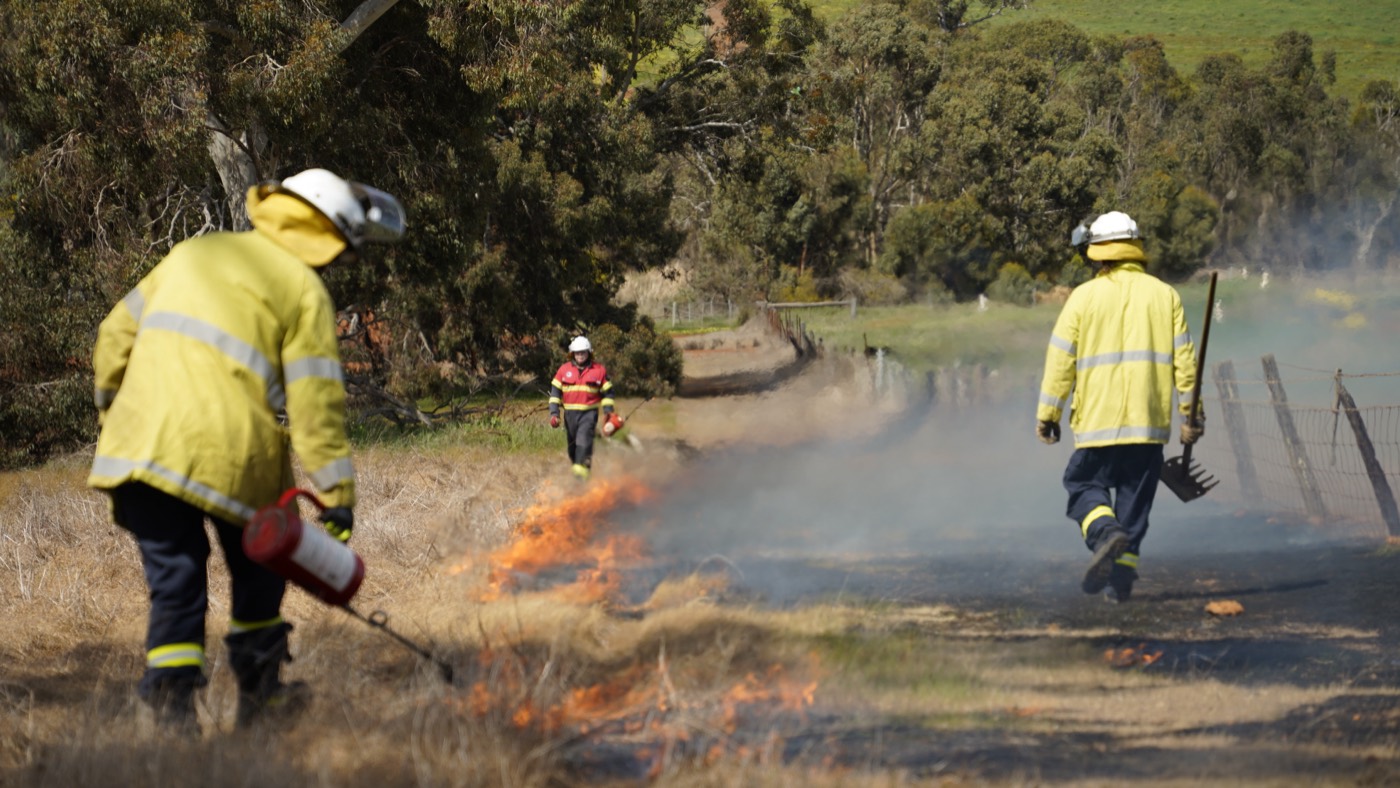
- Controlled live fire. Run safely, with suppression in place, so crews see how fire moves.
- Suppression drills. With your equipment, your water and your crew mix.
- A scenario that escalates. The ERT on the fire edge, site command making the calls above it.
- A debrief and a record. What held, what didn't, and evidence of competency.
Recent Work
We recently delivered on-site wildfire training in Boddington, Western Australia, with controlled live fire and suppression drills led by senior bushfire leaders.
Where This Lands
A bushfire won't wait for the next training cycle.
Your crews should have worked fire on their own ground before the day it matters.
Resolve Emergency Management
We deliver on-site wildfire training for ERT and ESO teams, led by senior bushfire leaders.
ESO and ERT training